Owe Back Gross Receipts Tax in New Mexico? What to Do Next
If the New Mexico Taxation and Revenue Department says you owe back gross receipts tax, start by finding the date on the notice and the deadline it gives you, then gather your records for every year it covers. Penalty and interest keep adding up on unpaid tax, and you have 90 days from the mailing date of an assessment to protest it. The fix usually means rebuilding several years of receipts, so most owners are better off handing the letter to a CPA who files gross receipts every month.
Why did I get a gross receipts tax letter from New Mexico?
Here is the version we see most. A one-person business files a federal return with a Schedule C showing $150,000 in receipts. The owner has never filed a New Mexico gross receipts tax return. The state compares the two, sees receipts it was never told about, and sends a letter.
That comparison is written into the state’s own records. In one published hearing decision, the department sent a Notice of Limited Scope Audit after finding a “Schedule C mismatch” between the owner’s federal Form 1040 and the gross receipts tax he had reported, then issued assessments for tax, penalty, and interest.
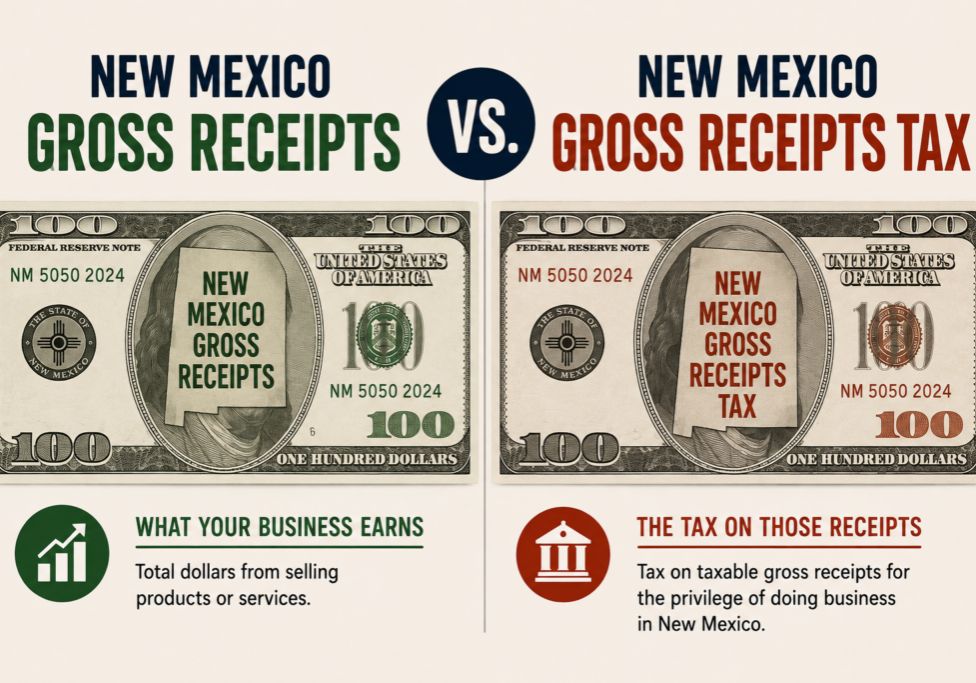
The owners who get these letters are rarely trying to dodge anything. They’re a traveling nurse on 1099 contracts, a silversmith selling at shows, or a contractor who went out on his own. Many think of it as a sales tax that stores collect. Gross receipts tax works differently. It’s charged to the business on its receipts, and it covers most services as well as goods. If you earn money from work done in New Mexico, assume the state expects a filing until someone confirms otherwise.
What penalties and interest apply to back gross receipts tax?
Two charges sit on top of the tax itself.
Penalty. The late filing and late payment penalty is 2% of the unpaid tax for each month or partial month it’s late, capped at 20%. On $6,000 of tax that’s ten months or more overdue, that cap is $1,200.
Interest. Interest accrues daily from the original due date. The department sets the rate each quarter, and it was 7% a year for the second half of 2026.
A letter that sits in a drawer for six months costs more than the same letter answered in two weeks.
What should you do first when the letter arrives?
- Find the dates. Note the mailing date and any response deadline. A limited scope audit notice may give you a set number of days to send records. An assessment starts the 90-day protest clock.
- Gather the years in question. Pull your federal returns, bank statements, 1099s, and invoices for every period listed. If some sales went to buyers who gave you nontaxable transaction certificates (NTTCs), find those too, because they can reduce what’s owed.
- Sort what was taxable and where. Rates depend on where the work was done or the goods were delivered, so a contractor working in Gallup and Farmington may owe different rates on different jobs.
- File the missing returns. Back returns are filed through the state’s Taxpayer Access Point (TAP), the same system used for current filings.
- Protest in writing if you disagree. If an assessment is wrong, the protest has to reach the department’s Protest Office within 90 days of the mailing date. You can’t pay the tax “under protest,” so decide which route you’re taking before you send money.
Can you reduce the penalty and interest?
Sometimes. New Mexico runs a managed audit program, sometimes called a self-audit, under a signed agreement with the Secretary of Taxation and Revenue. A business that qualifies discloses the tax it owes and avoids penalty and interest, as long as the resulting assessment is paid in full within 180 days. Miss that window and interest runs on the remaining balance from the original due date.
The department has opened the program to some liabilities it identified on its own, which wasn’t allowed before. Approval is still the department’s decision. Its published guidelines look at whether you’re willing and able to comply, whether your records hold up, and whether you’re already in a legal dispute with the department over whether the tax applies. If a letter has already arrived, ask about a managed audit before you file anything or pay the assessment.
How we handle gross receipts letters at Arsenault CPA
When one of our clients gets a letter from the state or the IRS, they forward it to us and we take care of it. That’s a big part of what clients are paying for. For a new client, back-filing missed gross receipts periods is handled as part of onboarding and priced by how far back it goes.
Then we change the setup so the letter doesn’t come back. We put every client on monthly gross receipts filing, prepared straight from current, reconciled books. Filing monthly keeps each return small and on time, and it means a slow month still gets a zero return instead of a missed one.
Arsenault CPA is based in Gallup and files gross receipts tax for businesses across New Mexico, from McKinley County to Albuquerque, Santa Fe, and Farmington. Everything runs online, so distance from our office doesn’t slow anything down. If a gross receipts letter is what finally made you realize the business needs a real back office, that’s the conversation we’re built for.
FAQ
Do I owe gross receipts tax if I only work on 1099 contracts? Usually. Gross receipts tax applies to most services performed in New Mexico, including work paid on a 1099. Some receipts are deductible or exempt, which is why a letter deserves a careful look before you pay it.
Is an IRS notice the same as a New Mexico gross receipts tax letter? No. An IRS notice is about federal income tax. A gross receipts letter comes from the New Mexico Taxation and Revenue Department and covers state gross receipts tax. Owners sometimes get both in the same year, since the state can use federal return data to find unreported receipts. We handle both.
How often will I have to file gross receipts tax going forward? The state allows monthly, quarterly, or semiannual filing depending on how much tax you owe, with returns due on the 25th of the month after the period ends. Monthly filing applies when combined taxes average more than $200 a month. We file monthly for every client so nothing piles up.
What if I had no income in a period? A return is still due. Filing a zero return keeps the account current and keeps the state from treating the period as missing.
Get the letter off your desk
Send us the letter and we’ll tell you what it means, what it will take to fix, and what monthly filing would look like for your business. Book a Consultation and you’ll leave knowing which package fits and exactly what it costs.