

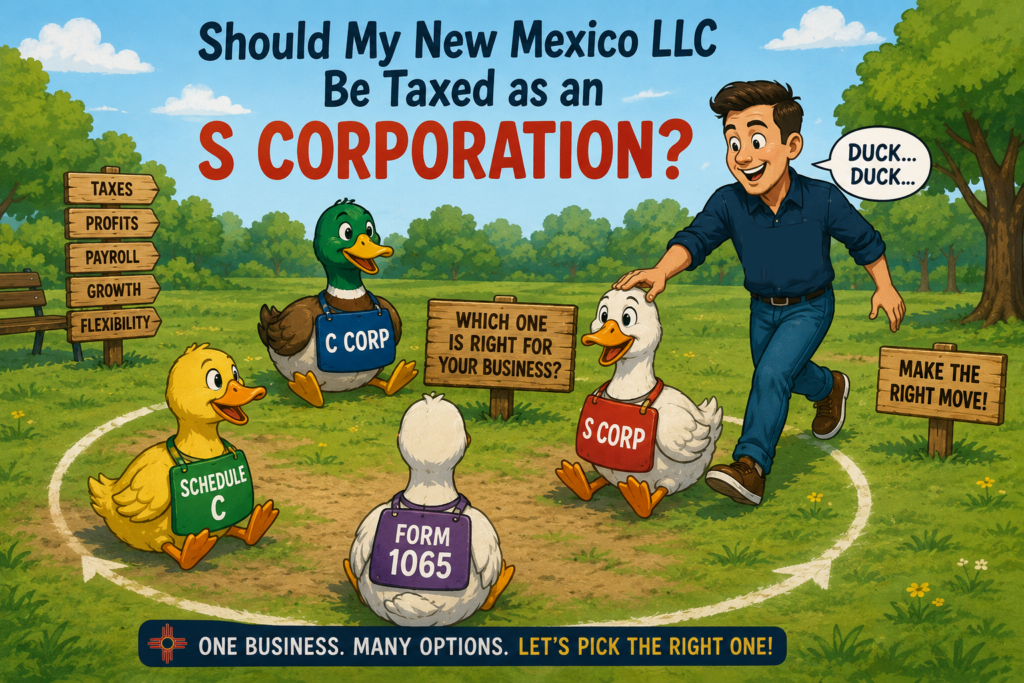
Short Answer
Maybe—but not every LLC should elect S Corporation status.
For many profitable small businesses, an S Corporation election can save thousands of dollars in self-employment taxes each year. However, it also comes with additional costs and responsibilities.
The decision should be based on your profits—not simply because someone told you every LLC should become an S Corporation.
Is an LLC the Same as an S Corporation?
No.
This is probably the biggest misconception we see with new business owners.
When I ask a new client, “How is your business taxed?” I often hear,
“I’m an LLC.”
While that’s true, it doesn’t answer the question.
An LLC (Limited Liability Company) is your legal structure.
An S Corporation is a tax election.
Think of it this way:
- Your LLC provides liability protection.
- Your tax election determines how the IRS taxes your business.
Those are two completely different things.
How Is an LLC Taxed by Default?
When you form an LLC, the IRS automatically assigns a tax classification.
Single-Member LLC
A single-member LLC is generally taxed as a sole proprietorship.
Business income is reported on Schedule C of your personal tax return.
Multi-Member LLC
A multi-member LLC is generally taxed as a partnership.
The business files Form 1065, and each owner receives a Schedule K-1.
In both cases, the business profits are generally subject to self-employment tax.
Don’t Forget Your EIN
One of the first things every new LLC should do is obtain an Employer Identification Number (EIN) from the IRS.
An EIN helps you:
- Protect your Social Security number
- Open a business bank account
- Establish business credibility
- Hire employees
- File business tax returns
Even single-member LLCs usually benefit from having one.
How Does an LLC Become an S Corporation?
If you decide an S Corporation makes sense, you’ll generally file IRS Form 2553 to elect S Corporation taxation.
Your legal entity doesn’t change.
Your LLC simply chooses to be taxed under the S Corporation rules.
Why Do Business Owners Elect S Corporation Status?
The answer is simple:
To reduce self-employment taxes.
Let’s look at a simple example.
Suppose your business earns $40,000 in annual profit.
If you’re taxed as a sole proprietor, that entire $40,000 is generally subject to self-employment tax.
At today’s rates, that’s approximately $6,120 in self-employment tax before considering federal or New Mexico income taxes.
Now assume your LLC elects S Corporation status.
Instead of treating all $40,000 as self-employment income, you pay yourself a reasonable salary of $20,000 through payroll.
The remaining $20,000 is generally distributed as an S Corporation distribution.
Those distributions are generally not subject to self-employment tax, creating potential tax savings.
This is where an S Corporation can become valuable.
When Does an S Corporation Make Sense?
There isn’t a magic number.
Every business is different.
However, as a general guideline, we typically begin discussing an S Corporation election once a business is consistently earning around $40,000 in annual profit.
Once profits are consistently above $50,000, it’s usually time to carefully evaluate whether the tax savings outweigh the additional costs.
What Additional Costs Come with an S Corporation?
An S Corporation isn’t free.
You’ll now have additional compliance requirements, including:
- Running payroll
- Quarterly and annual payroll tax filings
- Preparing Form 1120-S
- Maintaining payroll records
- Meeting the IRS reasonable compensation rules
Payroll processing alone often costs between $750 and $1,000 per year, depending on your payroll provider.
You’ll also have the cost of preparing an S Corporation tax return, which varies depending on the complexity of your business.
These additional costs are why we don’t recommend every LLC automatically become an S Corporation.
Additional Benefits of an S Corporation
While reducing self-employment tax is usually the primary reason for making the election, S Corporations offer other advantages as well.
Depending on your situation, these may include:
- Pass-through taxation with no federal income tax at the business level
- Potential Qualified Business Income (QBI) deduction eligibility
- Deductible retirement plan contributions
- Health insurance planning opportunities
- Accountable plans for reimbursing business expenses
- Potential loss deductions (subject to basis and other IRS limitations)
These strategies can create meaningful tax savings when properly implemented.
The Bottom Line
An LLC should almost always be part of the conversation when starting a business.
Whether that LLC should also elect S Corporation taxation depends on your profits, your long-term goals, and the cost of maintaining the additional compliance requirements.
It’s not a decision that should wait until your business has grown for several years.
It’s a conversation you should have with your CPA from the very beginning.
At Arsenault CPA Firm, we help New Mexico business owners evaluate whether an S Corporation election makes financial sense. We’ll estimate the potential tax savings, explain the additional compliance requirements, and help you choose the structure that’s best for your business today and as it continues to grow.
Quick Comparison
| LLC (Default Taxation) | LLC Taxed as an S Corporation | |
|---|---|---|
| Legal Liability Protection | ✅ | ✅ |
| Pass-Through Taxation | ✅ | ✅ |
| Self-Employment Tax | Generally applies to all profits | Generally applies only to reasonable compensation |
| Payroll Required | No | Yes |
| Separate Business Tax Return | Single-member: No Multi-member: Yes | Yes |
| Best For | New and lower-profit businesses | Consistently profitable businesses |
In our experience, the biggest mistake isn’t waiting too long to become an S Corporation. It’s never having the conversation at all.
Contact us Today!