

Short Answer
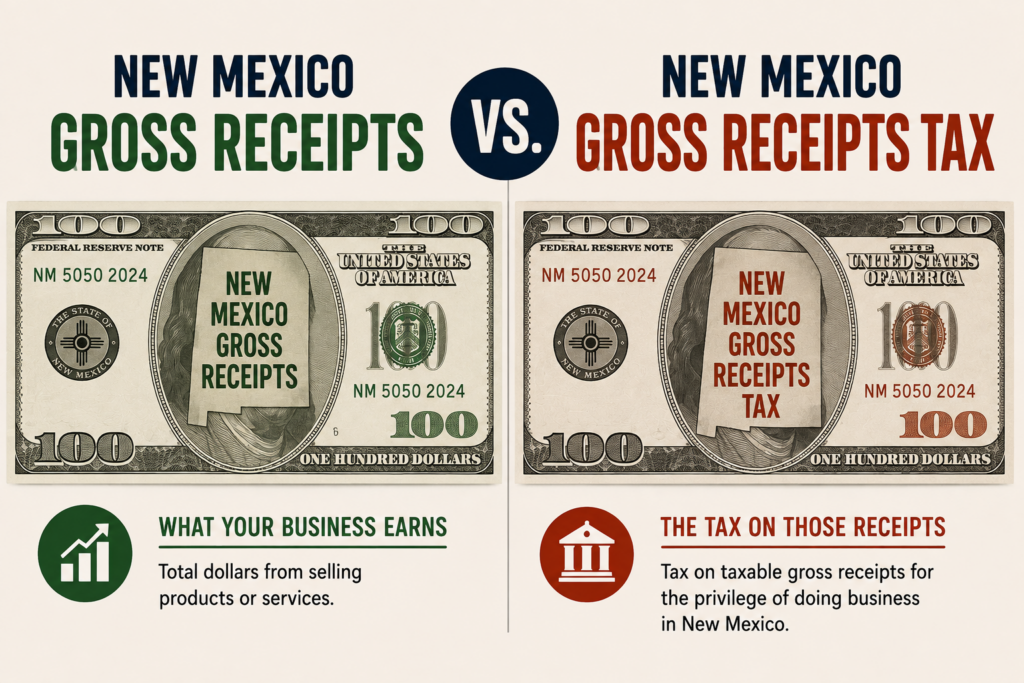
Gross Receipts are the total dollars your business receives from selling products or services.
New Mexico Gross Receipts Tax is the tax that may apply to those receipts.
They are related, but they are not the same thing.
What Are Gross Receipts?
Gross Receipts are essentially your business revenue before deductions.
It is the amount your business earned from selling products or providing services.
On your federal tax return, this amount is generally reported near the top of the business return.
For example:
- Schedule C: Part I, Line 1
- Form 1120: Line 1a
- Form 1120-S: Line 1a
- Form 1065: Line 1a
The federal government wants to know one simple thing:
How much did your business sell during the year?
New Mexico Taxation and Revenue wants to know the same thing.
Why Are Gross Receipts So Important?
Gross Receipts are usually the starting point for measuring the size of a business.
When someone says:
“My business did $500,000 last year.”
They are usually talking about gross revenue or gross receipts.
It is the amount of money coming into the business before expenses are deducted.
That number becomes the starting point for both federal income tax reporting and New Mexico Gross Receipts Tax reporting.
What Is New Mexico Gross Receipts Tax?
New Mexico Gross Receipts Tax, often called NM GRT, is a tax imposed on businesses for the privilege of doing business in New Mexico.
The tax is generally calculated using your gross receipts.
The important distinction is this:
Gross Receipts = Revenue
Gross Receipts Tax = Tax calculated on taxable Gross Receipts
Not every dollar of Gross Receipts is necessarily subject to Gross Receipts Tax.
Are All Gross Receipts Taxable?
No.
New Mexico allows a number of deductions and exemptions.
Some common examples may include:
- Wholesale transactions supported by an NTTC
- Certain services for resale
- Certain construction-related transactions
- Some receipts associated with customers outside New Mexico
- Other transactions specifically allowed by New Mexico law
This is where many business owners get confused.
They assume that because a transaction is not taxable, it should not be reported.
That is usually the wrong way to think about it.
Do I Report Nontaxable Sales in NM TAP?
Generally, yes.
New Mexico wants to know your total Gross Receipts.
You then separately report the deductions you are entitled to claim.
For example, assume your business had:
$500,000 in total sales
Of that amount:
- $400,000 was taxable
- $100,000 qualified for a deduction
You generally would not report only $400,000.
You would report the full $500,000 in Gross Receipts and then claim the appropriate $100,000 deduction.
The remaining taxable amount would be used to calculate Gross Receipts Tax.
Why Should My NM TAP Gross Receipts Match My Federal Tax Return?
This is an important concept.
Your federal tax return reports your business revenue.
Your New Mexico Gross Receipts Tax returns also report your business revenue.
Those numbers should generally make sense when compared with each other.
If your federal tax return reports $500,000 in Gross Receipts but your New Mexico filings report only $250,000, that difference may raise questions.
There may be a completely legitimate reason for the difference.
For example:
- Out-of-state sales
- Deductible transactions
- NTTC-supported sales
- Timing differences
But the difference should be explainable and properly documented.
A Common Wholesale Mistake
We see this frequently.
A wholesale business sells only to customers who provide valid Non-Taxable Transaction Certificates.
Because the business does not charge Gross Receipts Tax, the owner assumes they do not need to file New Mexico Gross Receipts Tax returns.
That is not necessarily correct.
The business still has Gross Receipts.
Those Gross Receipts are generally reported, and then the business claims the applicable deductions.
The tax may be zero, but the Gross Receipts still exist.
What If My Business Has Both Retail and Wholesale Sales?
The same concept applies.
Assume you have:
- $300,000 in retail sales
- $200,000 in wholesale sales
Your total Gross Receipts are $500,000.
You generally report the $500,000 and then claim the appropriate deduction for the wholesale transactions.
Reporting only the $300,000 in retail sales can make it appear that your New Mexico revenue does not match the revenue reported on your federal income tax return.
What Happens If I Don’t Report My Gross Receipts?
Ignoring New Mexico Gross Receipts Tax reporting can become expensive.
If New Mexico determines that Gross Receipts should have been reported, you may receive an assessment for unpaid tax.
That can also include:
- Penalties
- Interest
- Additional filing requirements
- Time spent correcting old returns
The longer the issue goes unresolved, the more difficult and expensive it can become to fix.
The Bottom Line
The easiest way to remember the difference is:
Gross Receipts are what your business earns.
Gross Receipts Tax is the tax calculated on the portion of those receipts that is taxable.
Even when some or all of your sales qualify for a deduction, New Mexico may still expect those Gross Receipts to be reported through NM TAP.
Understanding that difference is one of the most important parts of staying compliant as a New Mexico business owner.
And this is also one of those administrative jobs that most business owners probably should not be spending their evenings trying to figure out.
Your time is usually better spent selling your product, providing your service, and growing your business while your accounting team handles the monthly compliance work.